
Last Updated On : 12-Oct-2026
Total 33 Questions
The difference between a near pass and a confident pass isn't just knowing the material, it's mastering the Fortinet FCP Secure Wireless LAN 7.4 Administrator exam experience. Our Fortinet FCP_FWF_AD-7.4 practice test is engineered to close the gap between your current knowledge and the 2026 exam's demands. With every question, you receive detailed, expert verified explanations that break down not just the correct answer, but also the reasoning behind every incorrect option.
Don't just study. Practice FCP_FWF_AD-7.4 with purpose. Start your journey to a first-time pass today.
By replicating the exact style, complexity, and format of the real Fortinet FCP Secure Wireless LAN 7.4 Administrator exam questions, we ensure you walk into the exam with complete confidence.
Refer to the exhibit.
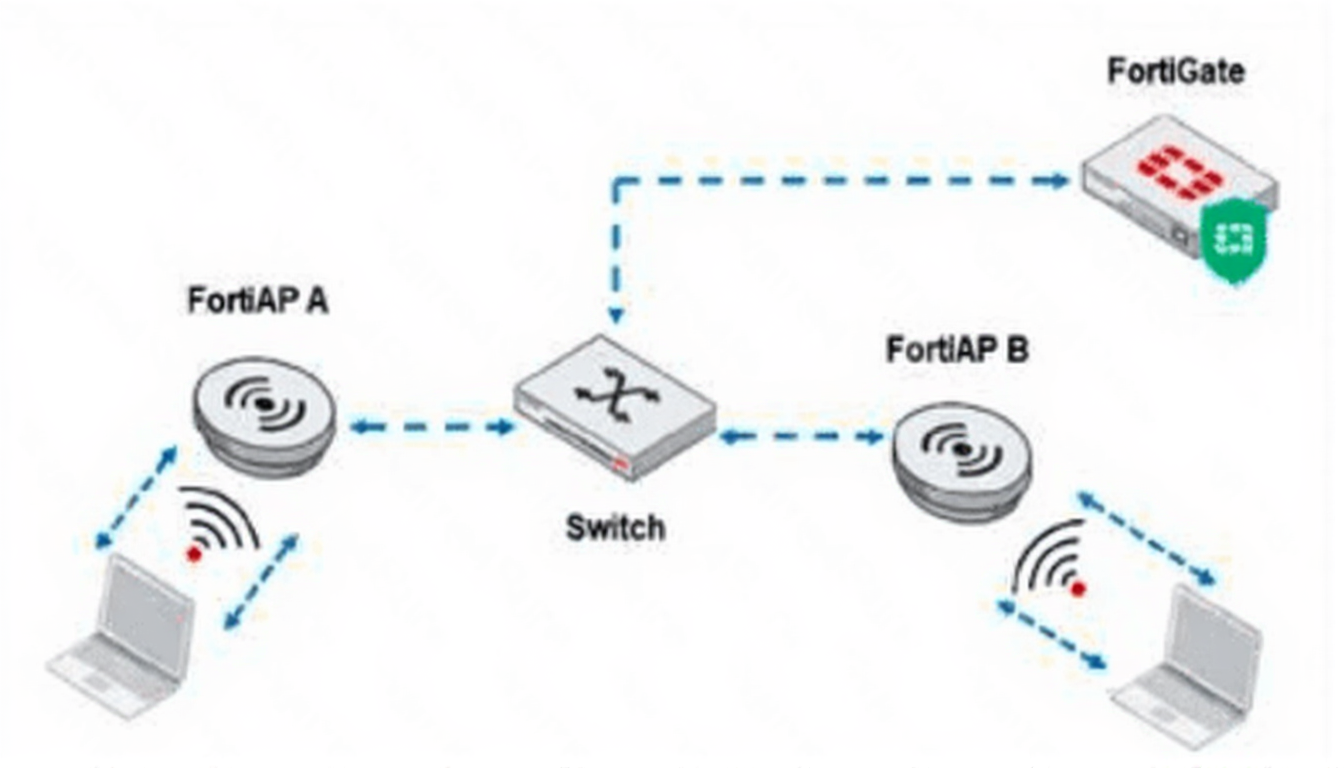
Which traffic is crucial between the FortiAP devices and FortiGate to support AP configuration updates and
management services?
A. Control traffic
B. Layer 2 traffic
C. Data traffic
D. License management traffic
Explanation:
For FortiGate to manage FortiAPs (configuration pushes, firmware updates, telemetry, and command control), CAPWAP control traffic is essential. This management tunnel carries commands, status, and provisioning data between the FortiGate and FortiAPs. Without this control channel, APs cannot receive configuration updates or be centrally managed.
Why other options are incorrect:
B. Layer 2 traffic:
Layer 2 connectivity (switching) is required for the underlying transport, but the specific crucial traffic for AP management is the CAPWAP control plane, not generic Layer 2 frames.
C. Data traffic:
Data traffic refers to client wireless user data (encrypted in the CAPWAP data tunnel). This is important for network functionality but not strictly required for AP configuration and management services.
D. License management traffic:
License validation occurs but is not the primary continuous traffic needed for configuration updates and live management. The CAPWAP control channel handles ongoing management.
Reference:
This aligns with the Fortinet CAPWAP architecture where control and data channels are separate. The FCP Wireless LAN curriculum specifies that the CAPWAP control tunnel is mandatory for AP provisioning and management.
An IT department must provide wireless security to employees connected over remote hortiAP devices who must access corporate resources at the mam office Which action must the IT department take to enforce security policies for all wireless stations accessing corporate resources across all remote locations?
A. Configure VPN tunnels to transport secured data between the main office and branch offices
B. Deploy further onsite IT personnel to these remote sites to enforce security inspection
C. Transfer local resources from corporate data centers to cloud services to offer access to remote users
D. Implement a teleworker topology to split traffic for further security inspection
Explanation:
The scenario describes a classic Fortinet Teleworker / Remote AP deployment. Employees at remote sites (homes, small offices) connect via FortiAPs and need secure access to corporate resources at the main office.
D. Implement a teleworker topology:
In a Fortinet Teleworker topology, the remote FortiAP establishes an IPsec VPN tunnel (via FortiGate or FortiClient EMS) back to the corporate network. A key feature is traffic splitting (split tunneling):
Why the other options are incorrect:
A. Configure VPN tunnels to transport secured data between the main office and branch offices:
This is partially correct but incomplete. A simple site-to-site VPN between offices does not inherently enforce security policies (like antivirus, IPS, web filtering) on the wireless user traffic. It only provides encryption. The Teleworker topology (D) specifically includes integrated security inspection (UTM/NGFW) on the tunneled traffic, which is the core requirement.
B. Deploy further onsite IT personnel to these remote sites to enforce security inspection:
This is neither scalable nor cost-effective. Fortinet's solution is designed for centralized management and policy enforcement without requiring local IT staff at every small/remote site.
C. Transfer local resources from corporate data centers to cloud services to offer access to remote users:
While cloud services can facilitate remote access, this does not address the requirement to enforce security policies for wireless stations. Moving resources to the cloud shifts the problem but doesn't solve how the company's security stack (UTM, NGFW) inspects and controls the traffic from the remote users' devices.
Reference:
This maps directly to the FCP - Secure Wireless LAN 7.4 objective covering FortiAP deployment modes and use cases. The Teleworker/Remote AP topology is a standard Fortinet design for securing remote users. Official Fortinet documentation describes this model as using an IPsec VPN tunnel with a virtual IP address for the remote user, where traffic can be split and corporate-bound traffic is subjected to the central FortiGate's UTM security profiles.
Which action does a wireless client or the access point take when the wireless client moves away from an associated AP until the signal drops?
A. The wireless client disconnects and connects to a different, available AP
B. The associated AP marks the wireless client as disconnected and must not reconnect
C. The associated AP sends an alert message to the wireless client about the signal drop
D. The wireless client increases its signal power to continue connecting to the same AP
Explanation:
When a wireless client moves out of range of its associated AP, the signal strength drops below the usable threshold, causing the client to lose connectivity. To regain network access, the client’s wireless driver will then scan for other available APs (matching the same SSID) and initiate a new association/authentication to a different AP with a stronger signal—this is the basic roaming process.
Why other options are incorrect:
B. The associated AP marks the wireless client as disconnected and must not reconnect:
The AP does mark the client as disconnected, but this does not prevent future reconnection. The client can reconnect later if it returns to range, or connect to another AP.
C. The associated AP sends an alert message to the wireless client about the signal drop:
APs do not send proactive signal-drop alerts to clients. They may send deauthentication/disassociation frames when the link fails, but this is not an "alert" about signal strength.
D. The wireless client increases its signal power to continue connecting to the same AP:
Client transmit power is generally fixed or dynamically adjusted within regulatory limits, but increasing power does not compensate for a weak incoming signal from the AP. Roaming to a closer AP is the standard behavior.
Reference:
This describes fundamental client roaming behavior, covered in the FCP Wireless LAN curriculum under wireless mobility and client connectivity principles.
What protection does WPA3 wireless encryption provide over WPA2 for securing wireless networks?
A. WPA3 uses 128-bit session key size
B. WPA3 enforces only enterprise security mode
C. WPA3 addresses the KRACK vulnerability
D. WPA3 prevents legacy and deprecated wireless protocols from being used
Explanation:
The primary security enhancement WPA3 provides over WPA2 is the replacement of the vulnerable 4-way handshake used in WPA2-Personal with Simultaneous Authentication of Equals (SAE), also known as Dragonfly Key Exchange. This new handshake protocol is fundamentally resistant to Key Reinstallation Attacks (KRACK), which exploited weaknesses in WPA2's handshake to intercept or decrypt traffic. SAE also provides forward secrecy, meaning a compromised session key cannot decrypt previously captured traffic, and strengthens protection against offline password-guessing attacks.
Why other options are incorrect:
A. WPA3 uses 128-bit session key size:
This is not a differentiating improvement. Both WPA2 and WPA3-Personal typically use 128-bit AES-CCMP for encryption. WPA3-Enterprise mode can optionally use a 192-bit cryptographic suite, but bit strength is not the defining security upgrade.
B. WPA3 enforces only enterprise security mode:
Incorrect. WPA3 is defined for both enterprise (WPA3-Enterprise with 802.1X) and personal (WPA3-Personal with SAE) use cases.
D. WPA3 prevents legacy and deprecated wireless protocols from being used:
WPA3 itself is a security protocol, not a filter for client capabilities. A network can be configured for WPA3-only mode (Transition Disabled), which rejects WPA2 clients, but this is a configurable policy choice, not an inherent feature of the WPA3 encryption standard.
Reference:
This aligns with the Wi-Fi Alliance's WPA3 certification requirements, which mandate the use of Protected Management Frames (PMF) and SAE to mitigate KRACK and offline dictionary attacks. The FCP - Secure Wireless LAN 7.4 curriculum specifically highlights SAE and its benefits over WPA2-PSK as a key exam objective for modern wireless security.
Which two rotes does FortiPresence analytics assist in generating presence reports'' (Choose two.)
A. Gathering details about on-site guest users
B. Reporting potential threats by on-site guest users
C. Comparing current data with historical records
D. Predicting the number of on-site guest users
Explanation:
FortiPresence is a Fortinet solution for location analytics and visitor tracking using Wi-Fi signals. Its core functions are to detect wireless devices, analyze movement patterns, and generate business intelligence reports—not for security threat detection or prediction.
A. Gathering details about on-site guest users:
FortiPresence collects data such as dwell time, foot traffic patterns, repeat visit rates, and device counts by location zone. This provides insights into customer/guest behavior and space utilization.
C. Comparing current data with historical records:
A key analytical feature is the ability to compare real-time data with historical trends (e.g., traffic versus last week, same period last year). This helps identify peak times, measure campaign effectiveness, and optimize operations.
Why other options are incorrect:
B. Reporting potential threats by on-site guest users:
FortiPresence is an analytics tool, not a security tool. Threat detection (rogue APs, malicious behavior) is handled by FortiGate’s wireless intrusion detection/prevention (WIDS/WIPS) and security event logs, not FortiPresence reports.
D. Predicting the number of on-site guest users:
FortiPresence provides historical and real-time data, but it does not include built-in predictive modeling or forecasting algorithms. Prediction would require additional AI/ML tools or manual analysis of the trends it provides.
Reference:
Fortinet’s official FortiPresence documentation defines its purpose for business intelligence, customer analytics, and operational insight using Wi-Fi proximity data. This aligns with the FCP Wireless LAN curriculum's coverage of value-added services beyond basic connectivity.
You must design a wireless network to accommodate wireless stations to access local resources and the internet The access level of these stations will vary based on the type of device and users
Which design must you use to provide wireless access that will fulfill these requirements?
A. Create user groups to assign wireless stations once connected to an SSID
B. Create multiple SSIDs for each level of network access
C. Create an SSID and enable dynamic wireless VLAN
D. Create an SSID and enable integrated wireless NAC
Explanation:
This scenario requires a single SSID to provide different access levels based on device/user type. Dynamic VLAN assignment is the correct design because it allows a single wireless network (SSID) to automatically place users into different VLANs (and thus different security policies, firewall rules, and network access) after authentication. This is typically driven by RADIUS attributes (like Filter-ID or Tunnel-Private-Group-ID) returned during 802.1X/EAP authentication.
Why other options are incorrect:
A. Create user groups to assign wireless stations once connected to an SSID:
While user groups exist for policy matching on the FortiGate, merely creating groups does not inherently enforce different network access levels at connection time for a single SSID. This approach lacks the automated, credential-based network segmentation required.
B. Create multiple SSIDs for each level of network access:
This would work but is a poor design practice. It increases management overhead, clutters the airwaves with excessive broadcast traffic (beacon frames), and provides a poor user experience (multiple network names).
D. Create an SSID and enable integrated wireless NAC:
Fortinet’s NAC (Network Access Control) can perform post-connection device/health checks and apply policies, but it generally acts after network layer access is granted. Dynamic VLAN assignment is a more fundamental and efficient method for initial network-level segmentation based on user/device role, which is the core requirement.
Reference:
This maps to the FCP - Secure Wireless LAN 7.4 objective covering advanced SSID configurations and segmentation. Fortinet’s design guide recommends dynamic VLAN assignment via RADIUS for role-based network access using a single, unified SSID to simplify the user experience and reduce wireless channel overhead.
Refer to the exhibit.

Which statement is correct about channels 52 through 144 in the 5 GHz band?
A. The channels will be scanned by the wireless intrusion detection system (WIDS)
B. The channels cannot be used because of regulatory channel restrictions
C. The channels can be used only when Radio Resource Provisioning is enabled
D. The channels are subject to dynamic frequency selection (DPS) regulations
Explanation:
In the 5 GHz band, channels 52 through 144 (U-NII-2 and U-NII-2 Extended bands, e.g., 5.260–5.725 GHz) are DFS-required channels. These frequencies are shared with radar systems (weather, military, aviation). APs using these channels must continuously monitor for radar signals and immediately vacate the channel if radar is detected, a process mandated by regulatory bodies (FCC, ETSI) to avoid interference.
Why other options are incorrect:
A. The channels will be scanned by WIDS:
WIDS scans for security threats (rogue APs, attacks), not for regulatory DFS compliance. DFS is a radio operation requirement, not a security feature.
B. The channels cannot be used because of regulatory restrictions:
These channels can be used, but only if DFS compliance is implemented. They are not universally prohibited.
C. The channels can be used only when Radio Resource Provisioning is enabled:
Resource Provisioning (RRP) manages channel/power optimization, but DFS is a separate regulatory requirement. DFS applies regardless of RRP settings.
Reference:
Fortinet’s channel planning documentation specifies DFS requirements for U-NII-2/2e channels. This is covered in the FCP Wireless LAN curriculum under radio frequency and regulatory domain considerations.
| Page 1 out of 5 Pages |
| 123 |
The Fortinet FCP Secure Wireless LAN 7.4 Administrator exam is notoriously tough. It doesn't test memorization. It forces you to make complex decisions under time pressure. A weak prep strategy risks a costly failure and wasted effort. Our FCP_FWF_AD-7.4 practice tests are built to be your definitive bridge to a passing score.

Copyright © - All Rights Reserved